

Speaker
Professor Dr. Srinath Perera
Western Sydney University, Australia
Title
Digital Approaches to Sustainability and Circular Economy
The construction sector is a major contributor to global economic development, yet it remains one of the largest consumers of natural resources and generators of greenhouse gas emissions, waste, and environmental degradation. As nations pursue net-zero commitments and sustainable development goals, the construction industry faces increasing pressure to transform traditional linear production and consumption models into more sustainable and circular systems. Simultaneously, the emergence of Industry 4.0 technologies is reshaping the way built assets are designed, constructed, operated, maintained, and ultimately repurposed.
This keynote explores how digital transformation can accelerate sustainability and circular economy outcomes across the built environment. Drawing upon contemporary research and industry collaborations undertaken by the Centre for Smart Modern Construction (c4SMC) at Western Sydney University, the presentation examines the role of advanced digital technologies including Artificial Intelligence (AI), Blockchain, Internet of Things (IoT), Building Information Modelling (BIM), Digital Twins, and extended reality technologies in enabling data-driven sustainability decision-making throughout the asset lifecycle.
The keynote will demonstrate how digital technologies can support the transition from static and fragmented information systems towards connected, transparent, and real-time sustainability ecosystems. Particular attention will be given to emerging research on material passports, Environmental Product Declarations (EPDs), embodied carbon and embodied water estimation, ESG performance monitoring, carbon accounting and trading, construction and demolition waste circularity, and digital supply-chain traceability. These initiatives illustrate how digital infrastructures can improve resource efficiency, enhance material recovery, support regulatory compliance, and enable evidence-based sustainability reporting.
The presentation will further showcase c4SMC's multidisciplinary research agenda, which integrates expertise from construction management, engineering, computer science, and digital innovation to address sustainability challenges through collaborative partnerships with industry, government, and professional bodies. Recent research demonstrates how blockchain-enabled provenance systems, IoT-enabled sensing networks, and AI-driven analytics can facilitate circular economy practices by improving transparency, accountability, and lifecycle management of built assets.
The central argument of this keynote is that the future of sustainable construction lies not merely in digitising existing processes, but in creating intelligent and interconnected data ecosystems that enable continuous measurement, optimisation, and regeneration of environmental, social, and economic value. By presenting practical examples and research insights, the keynote aims to stimulate discussion on how digital technologies can be harnessed to create a more resilient, resource-efficient, and circular built environment for future generations.
Speaker
Professor Dr. Fauziah Ahmad
Universiti Sains Malaysia, Malaysia
Title
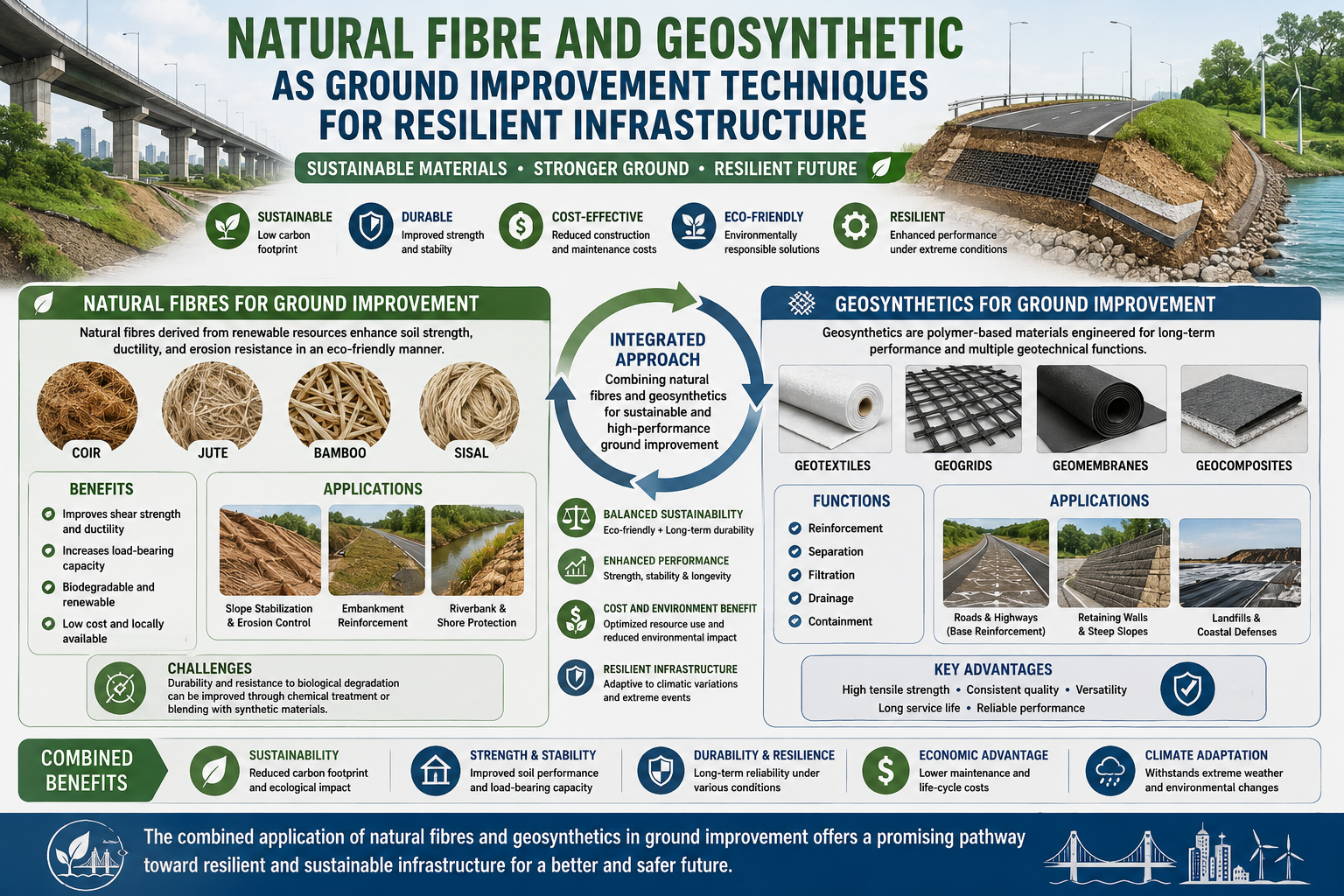
Natural Fibre and Geosynthetic as Ground Improvement Techniques for Resilient Infrastructure
The development of resilient infrastructure requires
sustainable, durable, and cost-effective solutions to address challenges posed
by weak or problematic soils. Ground improvement techniques play a crucial role in enhancing soil strength, stability, and performance under various loading
and environmental conditions. Among the emerging and widely adopted materials in this field are natural fibers and geosynthetics.
Natural fibers, derived from renewable resources such as coir, jute, bamboo, and sisal, offer an environmentally friendly alternative for soil reinforcement. They improve the shear strength, ductility, and load-bearing capacity of soils while maintaining biodegradability and low carbon footprint. Their use aligns with sustainable construction goals, particularly in temporary or low-cost applications such as slope stabilization, embankment protection, and erosion control. However, limitations in durability and resistance to biological degradation remain key challenges, often mitigated through chemical treatments or blending with synthetic materials.
Geosynthetics, on the other hand, are polymer-based materials engineered for long-term performance and versatility. They include geotextiles, geogrids, geomembranes, and geocomposites, which serve functions such as reinforcement, separation, filtration, drainage, and containment. Their consistent quality, high tensile strength, and long service life make them indispensable in modern geotechnical and infrastructure projects — from highways and retaining structures to landfills and coastal defenses.
The integration of natural fibers and geosynthetics represents a balanced approach to achieving both sustainability and resilience. While geosynthetics ensure long-term structural reliability, natural fibers contribute to ecological sustainability and cost efficiency. Together, they support the development of infrastructure that is not only strong and adaptable but also environmentally responsible.
In conclusion, the combined application of natural fibers and geosynthetics in ground improvement offers a promising pathway toward resilient and sustainable infrastructure, capable of withstanding climatic variations, reducing environmental impact, and ensuring long-term service performance.

Speaker
Professor Dr. Saroj Mandal
Jadavpur University, India
Title
Self-healing as Preventive Repair of Concrete Structures
Concrete is the most widely used construction material for infrastructure; however, cracking is inevitable due to shrinkage, thermal stresses, and mechanical loading. These cracks provide pathways for the ingress of water, oxygen, and aggressive chemicals such as chlorides and sulphates, which accelerate reinforcement corrosion and deterioration of concrete structures. Early detection and repair of micro-cracks are often difficult, expensive, and sometimes impractical. Consequently, the concept of self-healing concrete has emerged as an innovative approach that enables concrete to autonomously repair cracks, thereby improving durability and reducing long-term maintenance requirements.
Self-healing in concrete occurs through two main mechanisms: autogenous healing and engineered (autonomic) healing. Autogenous healing is the natural ability of concrete to seal very small cracks due to continued hydration of unhydrated cement particles, precipitation of calcium carbonate, and swelling of hydration products in the presence of moisture. This mechanism is generally effective for crack widths less than about 100–200 μm. The efficiency of natural healing can be enhanced through the use of supplementary cementitious materials such as fly ash, slag, and silica fume, which promote additional formation of calcium silicate hydrate (C–S–H) and improve the microstructure of concrete.
Recent research has focused on engineered self-healing systems to improve crack-repair capability beyond natural mechanisms. One promising approach is bacterial or microbial self-healing concrete, where bacteria capable of producing calcium carbonate or other deposits, are incorporated into the concrete matrix. When cracks occur, these microorganisms activate and precipitate, which fills and seals the cracks. Experimental studies have shown that bacterial concrete can achieve significant crack sealing efficiency and improved durability performance by reducing permeability and chloride penetration.
Another emerging technology involves microcapsule-based healing systems, where capsules containing healing agents such as polymers or mineral solutions are embedded in concrete. When cracks propagate through the matrix, the capsules rupture and release the healing agents, which subsequently seal the cracks. In addition, recent studies are exploring the integration of self-healing technologies with sustainable cement systems and advanced materials, including fibre-reinforced composites and low-carbon binders, to enhance both durability and environmental sustainability.
In conclusion, self-healing concrete represents a paradigm shift from reactive repair to preventive maintenance in concrete infrastructure. By enabling automatic crack sealing and improving resistance to environmental deterioration, this technology has the potential to significantly extend the service life of structures, reduce life-cycle costs, and contribute to the development of sustainable and resilient infrastructure systems in the future.
Speaker
Ir. Ts. Gs. Dr. Safari Hj. Mat Desa
National Water Research Institute of Malaysia (NAHRIM), Malaysia
Title
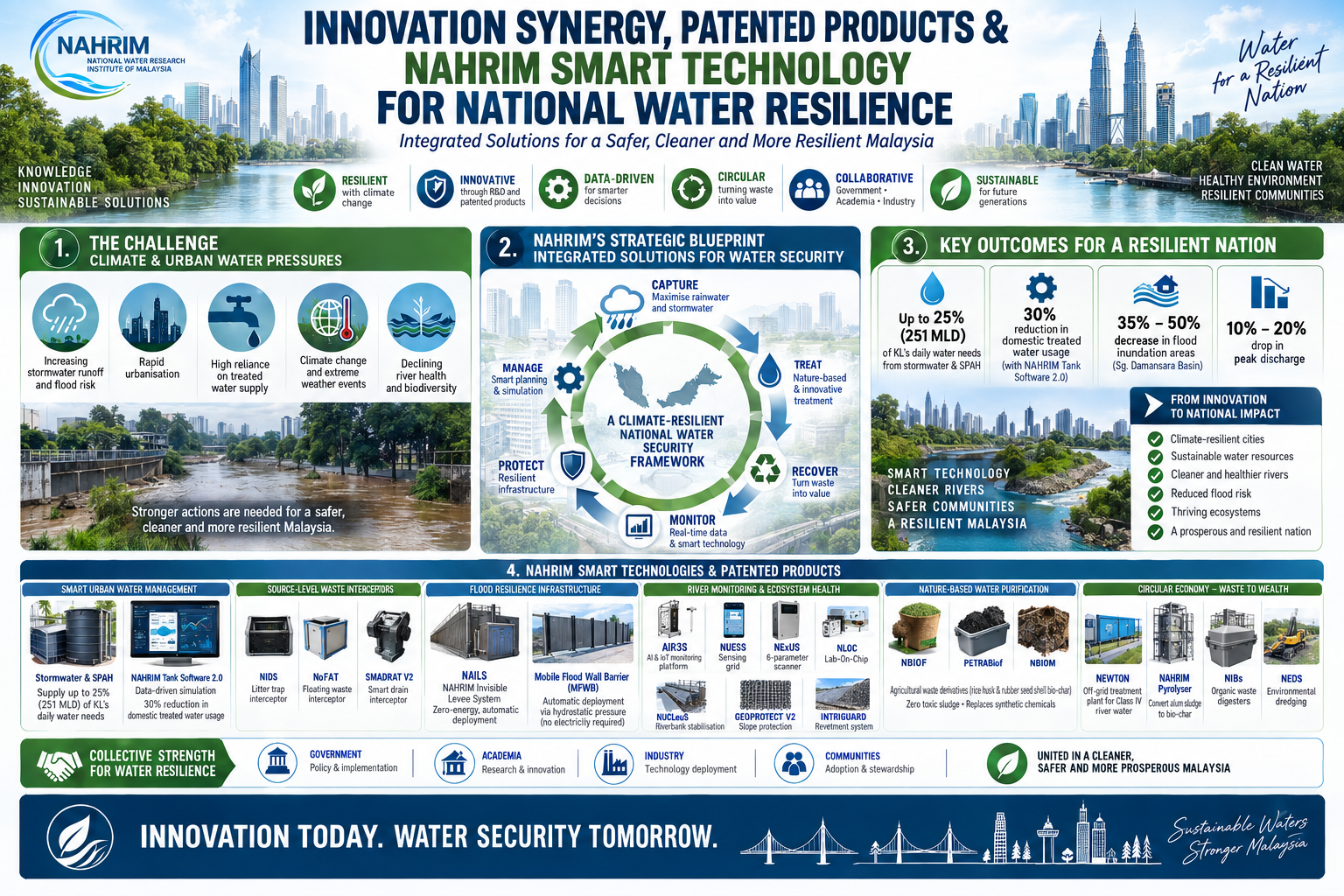
Innovation Synergy, Patented Products & NAHRIM Smart Technology for National Water Resilience
NAHRIM's strategic blueprint establishes a climate-resilient national water security framework that moves beyond conventional concrete infrastructure to align civil engineering with planetary sustainability. The framework optimizes urban water management by converting stormwater and Rainwater Harvesting Systems (SPAH) to supply up to 25% (251 MLD) of Kuala Lumpur's daily water needs. Using NAHRIM Tank Software 2.0, data-driven simulations yield of 30% reduction in domestic treated water usage, 35% to 50% decrease in flood inundation areas across the Sg. Damansara Basin, and contribute 10% to 20% drop in peak discharge. Resilience infrastructure is further bolstered by source-level waste interceptors—including in-house developed product by NAHRIM such as NIDS, NoFAT, and SMADRAT V2—alongside zero-energy passive flood barriers, NAILS (NAHRIM Invisible Levee System) and Mobile Flood Wall Barrier (MFWB) that deploy automatically via hydrostatic pressure without requiring electricity.
To ensure real-time environmental oversight and sustainable treatment, the blueprint integrates smart digital platforms, eco-engineering, and circular economy models. River health and biodiversity are continuously monitored using the Artificial Intelligence (AI) and IoT-powered AIR3S platform, supported by field-deployed sensing grids like NUESS, NExUS (6-parameter scanner), NLOC (Lab-On-Chip), and riverbank stabilization structures including NUCLeuS, GEOPROTECT V2, and INTRIGUARD. In water purification, Nature-Based Solutions such as NBIOF, PETRABiof, and NBIOM replace synthetic chemicals with agricultural waste derivatives (rice husk and rubber seed shell bio-char) to achieve zero toxic sludge. This is reinforced by a circular "Waste-to-Wealth" ecosystem featuring the off-grid NEWTON treatment plant for Class IV river water, the NAHRIM Pyrolyser for converting alum sludge into bio-char, NIBs organic waste digesters, and NEDS environmental dredging—collectively uniting Government, academia, and industry into a unified national water defense grid.